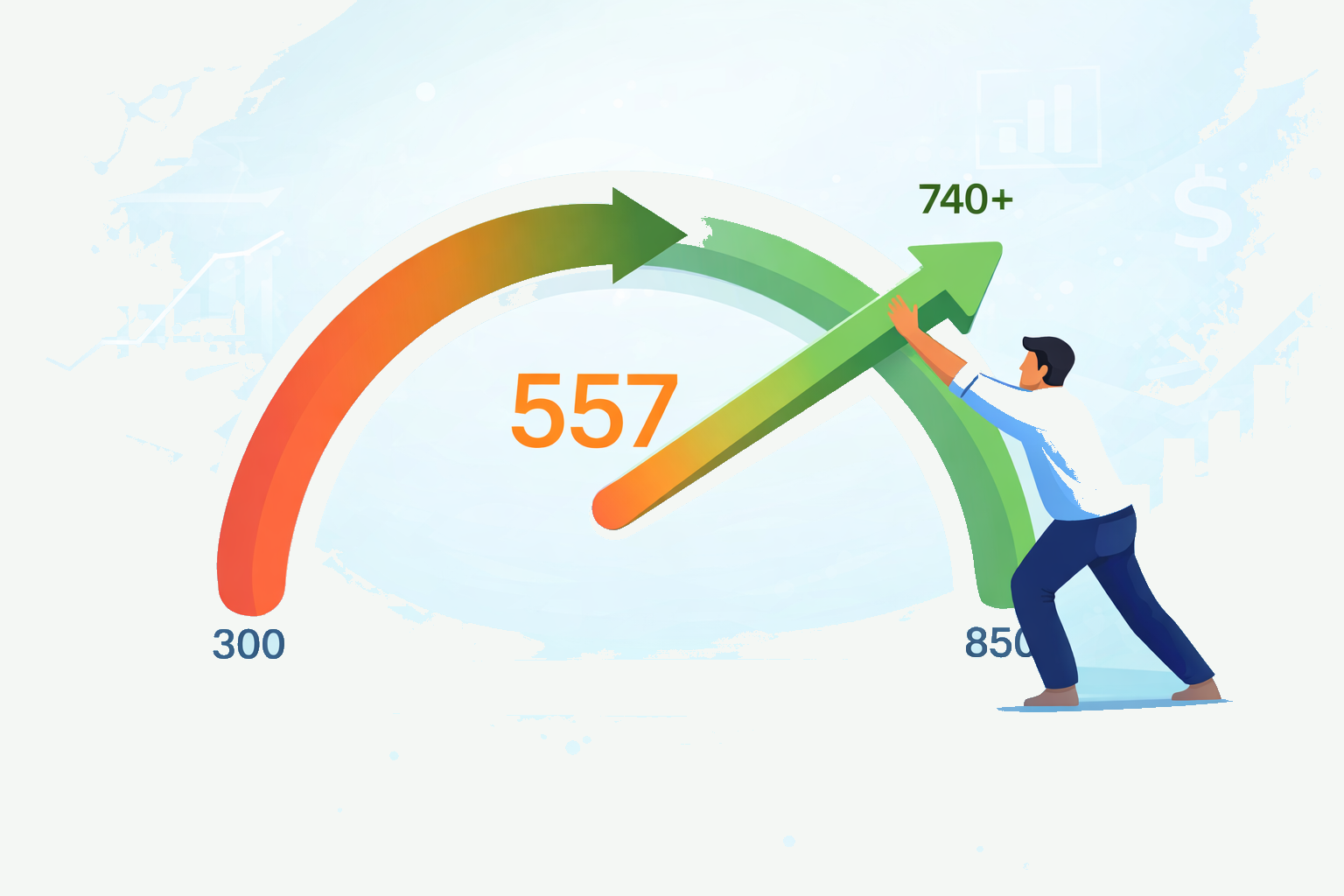

People worry that a legal name change wipes out their credit history. It does not. What it can do is fragment the file at the bureaus when creditors start reporting the new name and the bureau cannot match the new data to the existing file. The fix is mechanical and the order matters. This guide walks through why the score itself is safe, where the file actually breaks, and the exact sequence to keep your history intact through marriage, divorce, gender-affirming change, naturalization, or a court-ordered correction.
Legal Name Change & Credit: The TL;DR
- ›A name change does not directly affect your credit score — name is not a scoring factor.
- ›The risk is a split or fragmented file when creditors report the new name to a different bureau key.
- ›Fix is order of operations: SSA first, then DMV, then creditors, bureaus only if needed.
- ›Pull all three reports 60 days after creditor updates and check for missing accounts.
- ›A bureau dispute under FCRA Section 611 — with file disclosure under Section 609 — forces a manual file merge.
Why a Legal Name Change Doesn't Directly Hurt Your Credit Score
Credit scoring models — FICO and VantageScore — do not use your name as a scoring factor. The myFICO “what is not in your score” page lists the inputs explicitly: payment history, amounts owed, length of history, new credit, and credit mix. Name, marital status, and gender are not among them. The bureaus key files on a combination of Social Security number, date of birth, current and former addresses, and the names that have appeared on accounts over time. Change one variable in that key — your name — and the underlying account data is the same.
So when people see their score move after a name change, the cause is almost always indirect:
- A creditor updated the name slowly, and during the lag the file looked thinner.
- A fragmented file formed and a score pulled under the new name returned only partial history.
- New credit applications during the transition added inquiries.
- Identity-verification flags during the change triggered a temporary freeze on a card or two.
- Joint or co-signed accounts changed during marriage or divorce, which shifts utilization or limits.
The name itself is not the problem. The reporting plumbing under it is. If your scores diverge across bureaus during the transition, run the same workflow used for any score anomaly — credit score debugging — before assuming permanent harm.
The Real Risk: Split or Fragmented Credit Files
A split file — also called a fragmented file or a file segmentation issue — appears when account data the bureau receives no longer matches the existing file's identifiers cleanly. The matching algorithm at each bureau is proprietary, but it generally weighs SSN, name, DOB, and address. If too many of those change at once, or if creditors furnish data with an inconsistent combination (old name with new address, or new name where the SSN-on-file was already mismatched), the bureau may open a partial duplicate file rather than merge.
The result is two records:
- One under the old name with some of your accounts.
- One under the new name with the accounts that were updated cleanly.
Either file looks thinner than your real history. A lender pulling a report under the new name may see five years of history when the real file is twelve. A score generated from a fragmented file is often 30 to 80 points lower than the score from the merged file, simply because length of history and total account count both shrink.
| Scenario | What you see | Why it matters |
|---|---|---|
| Normal transition | Old name appears as alias; all accounts present | History stays intact; score logic is consistent |
| Fragmented transition | Some accounts only under new-name file, others only under old-name file | Lenders may pull incomplete data and underwrite as thinner risk |
| Post-dispute merged file | Single file shows both names and complete tradelines | Stable underwriting view returns |
This is the same reporting failure mode that triggers a mixed file from a similar-name mixup, with the legal name change as the triggering event instead.
The Correct Order of Operations: SSA First, Bureaus Last
The order of operations is the single most important part of this whole process. Skip a step or do them out of sequence and the bureau matching gets harder.
| Step | What you do | Why it matters |
|---|---|---|
| 1. Social Security Administration | File Form SS-5 with the court order, marriage certificate, or naturalization paperwork. SSN does not change; the name on file does. | The SSA-IRS data exchange and downstream creditor verification systems read from this record. |
| 2. DMV / driver's license / state ID | Update your photo ID with the new name. | Most creditors require government photo ID before they will process a name-change request. |
| 3. Passport (if applicable) | Form DS-5504 (recent passport) or DS-82 (renewal). | Some creditors and federal benefits programs accept passport as primary ID. |
| 4. IRS | No separate form needed. SSA propagates the update via the SSA-IRS exchange. | File your next return under the new name only after SSA has processed the change. |
| 5. Every active creditor | Banks, credit cards, mortgage, auto, student loans, BNPL, utilities, insurance, brokerage, retirement accounts. | This is the step that actually drives the bureau update. Skip a creditor and that account either stays under the old name or never refreshes. |
| 6. Employer / payroll | Update W-4 and payroll records. | W-2 reporting under the wrong name causes IRS friction the following spring. |
| 7. Bureau check (60 to 90 days later) | Pull all three reports from AnnualCreditReport.com. | Verify the new name appears, the old name appears as an alias, and every account is present. |
| 8. Bureau dispute (only if needed) | Submit a formal dispute with documentation if the file is split or accounts are missing. | This is the manual merge channel under FCRA Section 611. |
The most common failure mode is skipping step 5 — assuming the bureaus update on their own — and discovering the split file three months later when applying for a mortgage.
How to Notify Each Creditor
Every creditor has a slightly different process, but the documentation is consistent: certified court order or marriage certificate, updated SSA card, government photo ID. Most accept these documents by secure upload through the account portal. Some still require notarized copies by mail.
Work through this list in roughly this order, prioritizing the accounts most likely to report on your credit:
- Primary credit cards, in order of credit limit (high limit first, since those carry the most file weight).
- Mortgage servicer.
- Auto loan or lease servicer.
- Federal student loan servicer (and any private student loan holders).
- Personal loans, credit-builder loans, BNPL accounts.
- Bank checking and savings (these do not report directly but matter for ChexSystems and verification).
- Utilities, cell phone carriers, internet — even when not reporting, a mismatch here can flag identity-verification systems later.
- Brokerage, retirement accounts (IRA, 401k), HSA.
- Insurance — auto, home, life, health.
- Employer payroll.
- Subscription billing (matters less for credit but reduces friction during identity verification).
Keep a simple tracking sheet with date submitted, channel used, documents provided, confirmation number, and expected reporting month. When a creditor confirms the change, note the date and the next billing cycle — the bureau update typically lands in the cycle after that. The log also protects you if you later need to dispute under FCRA Section 611.
How the Bureaus Update Your Name
The bureaus update your name from creditor-furnished data, not from a consumer-facing portal. When a creditor sends a regular monthly update to Equifax, Experian, and TransUnion, the file it submits includes the account holder's name as the creditor has it on record. If you updated the creditor cleanly, the next monthly update lands at the bureau with the new name attached.
The bureau then either:
- Merges the new-name update into the existing file as the current name, with the old name moved to the “AKA” or “Other Names” section, or
- Treats the new-name update as a new file fragment if the matching algorithm cannot reconcile the change.
Outcome 1 is the goal. Outcome 2 is the split file. Which one happens depends on how many identifiers changed at the same time and how clean the data was that the creditor furnished. If you also moved house and only updated your address with two of three bureaus, and your creditor updated all three, you have introduced two identifier shifts at once. That is when fragmentation risk goes up.
A temporary alias entry under the old name is normal and useful. The goal is not to scrub the prior name immediately; the goal is a complete, accurate, single credit file. Experian's published guidance walks through how the alias section works.
How to Detect a Split File Early
Sixty days after the last major creditor confirms your name change, pull a free three-bureau report from AnnualCreditReport.com. This is the federally authorized free-report source and the right starting point — it is not a credit-monitoring app. For the basics of reading what comes back, see how to read a credit report.
Check each report for:
- The new name in the personal information section.
- The old name listed as an “Other Names” or “AKA”.
- Every active account present, with current balance and credit limit.
- Address history that includes the address you used during the change.
- No duplicate accounts under different name spellings.
- Oldest-account date matches your real history (a sudden drop is the loudest fragmentation signal).
Compare the three reports against each other. They will not be identical — that is normal, and explained in why scores are different across bureaus. What you are looking for is missing accounts or accounts that appear on one bureau but not the others under the new name. That is the early warning sign of fragmentation.
Do not wait for a mortgage preapproval to find this. A split discovered during underwriting creates deadline pressure and can raise closing risk.
How to Fix a Split File: Disputes Under FCRA
When a split file is confirmed — accounts missing, name not propagated, partial duplicate file under the new name — the fix is a formal dispute under FCRA Section 611 asking the bureau to merge the files. Pair it with a Section 609 file disclosure request to confirm what each bureau actually has on you.
Send a separate dispute to each affected bureau with:
- A cover letter explaining the legal name change and asking the bureau to merge the two files.
- Certified court order, marriage certificate, divorce decree, or naturalization paperwork showing the name change.
- Updated Social Security card.
- Current government photo ID with the new name.
- Proof of address (recent utility bill or bank statement).
- Optionally, a list of accounts that are missing from one file and should appear after the merge.
Send by certified mail with return receipt. Each bureau has its own mailing address for disputes; use the address listed on the report itself, not a generic customer service address. The Equifax dispute page and TransUnion dispute page both publish the current mailing addresses.
Suggested dispute language: “My credit file appears fragmented between my prior legal name and current legal name. I am requesting reinvestigation under FCRA Section 611 and a manual merge of all tradelines associated with my SSN into a single file. Please retain my prior legal name as an alias for matching continuity.”
Under FCRA Section 611, the bureau has 30 days to investigate and respond — extended to 45 days if you submit supplemental information during the initial 30-day window. The response is either a merge confirmation, a request for additional documentation, or a refusal. If the dispute is refused without a clear reason, escalate by filing a complaint with the Consumer Financial Protection Bureau and re-submitting. Persistent fragmentation, especially when documentation is clearly in order, is a recognized failure mode that the CFPB tracks.
Common Mistakes During Name Changes
Most of the credit damage from a name change comes from one of these mistakes:
- Skipping the creditor step. Updating SSA and the DMV but not the creditors leaves accounts reporting under the old name. The new file at the bureau, if one forms, will be thin.
- Updating creditors before SSA processes the change. Some creditors verify against SSA records. If SSA has not updated, the request is rejected and you waste a billing cycle.
- Changing address at the same time without coordination. Two identifier shifts at once (name plus address) increase fragmentation risk. If both are unavoidable, prioritize SSA and creditors before any address-only updates.
- Disputing factual late payments because the account was changing names. A late payment that occurred during the transition is still a late payment. The dispute mechanism is for inaccurate data, not for legal renaming.
- Opening multiple new accounts during the transition. Inquiries pile up, average account age drops, and the new accounts may report under one name while older accounts still report under the other.
- Assuming joint or authorized-user accounts update automatically. They do not. Each holder on a joint account must update their own name on the account separately.
- Trying to scrub the old name from the alias list. The alias is what keeps history linked. Removing it can cause the very split file you are trying to avoid.
Special Cases: Marriage, Divorce, Gender-Affirming, Naturalization
The credit mechanics are the same across cases, but the surrounding context changes the priorities:
- Marriage. Coordinate with your spouse on any joint accounts and authorized-user links. See marriage and credit for the full pre- and post-marriage checklist.
- Divorce. Name change often happens alongside joint-account separation. Do the joint-account work first — see rebuilding credit after divorce — and treat the name change as the closing step rather than the opening one.
- Gender-affirming legal change. Most state courts now issue an order that updates name and sex marker together. The credit-side process is identical to any other court-ordered change. All three bureaus — Equifax, Experian, and TransUnion — have specialized workflows for deadname suppression on the file. TransUnion's guidance on transgender name changes documents the request channel; Experian and Equifax handle these by mailed dispute with the court order. Ask in writing and keep certified-mail receipts.
- Naturalization. A new SSA record and updated naturalization certificate take precedence. See immigrant credit building for the broader file-building roadmap that accompanies naturalization.
- Court-ordered correction (typo, restored birth name). Mechanically the same, but the name change usually has the smallest reporting footprint because only one or two identifiers shift.
Should You Freeze Your Credit During the Transition?
A credit freeze is free at all three bureaus and reversible in minutes. It blocks new accounts from being opened in either name without your PIN. The case for freezing during a name change is straightforward — court records are sometimes searchable, name changes can attract identity-theft probes, and the transition window is exactly when fraudulent applications under the old or new name are hardest for a creditor to flag.
Use a freeze if you are not applying for new credit in the next 30 to 90 days, you have reason to expect fraud, or you want tighter control while records update. Skip or limit the freeze if you are rate-shopping for a mortgage, opening essential new accounts during the transition, or likely to forget temporary thaws before lender pulls. A fraud alert is lighter weight when active credit shopping is expected.
If you have already had identity theft, freeze is not optional. The full recovery sequence is in identity theft credit recovery.
A 90-Day Checklist for a Clean Name-Change Credit Transition
| Window | Actions |
|---|---|
| Day 0 | File SS-5 with SSA. Update DMV and passport. |
| Days 1 to 14 | Wait for SSA processing (typically 2 to 4 weeks). |
| Days 15 to 30 | Notify all creditors with documentation. Track confirmations. |
| Days 30 to 45 | Update employer payroll, brokerage, insurance, utilities. |
| Day 60 | Pull all three bureau reports from AnnualCreditReport.com. Inventory accounts. Save report confirmation numbers for the next step. |
| Day 75 | Submit bureau disputes for any fragmented accounts under FCRA 611, with file disclosure under Section 609. |
| Day 90 | Re-pull reports to confirm merges. Run Credit Optimizer for a clean diagnostic. |
If the file is clean at day 90, the transition is done. If not, the dispute cycle continues for another 30 days and the optimizer flags the remaining suppressors.
How the Credit Optimizer Fits a Name-Change Transition
The Credit Optimizer is the diagnostic step in this process. After a name change, it is the fastest way to detect a fragmented file before a lender sees one. The tool reads all three bureau reports and flags missing accounts, alias mismatches, address discrepancies, and the score gap between bureaus that signals fragmentation. For the broader recovery context, the Master Credit Recovery Roadmap places the name change inside the wider transition framework.
Run a Free Three-Bureau Split-File Diagnostic
A name change is a quiet credit event. Most of the damage happens in the 60-to-90-day window after the change, when a fragmented file is silently forming and no one is looking at all three bureau reports together. Run the Credit Optimizer for a free three-bureau diagnostic that flags missing accounts, alias mismatches, and the score gap that signals a split file before a lender sees it.
Run Credit OptimizerFor the broader transition framework, see the Master Credit Recovery Roadmap and the full Life Transition library for adjacent guides on marriage, divorce, and rebuilding from bankruptcy.
Related life-transition guides
Get Your Personalized Credit Roadmap
Upload your credit report and our Credit Analyzer identifies what may be holding your score back and provides a step-by-step report-based improvement plan.
Analyze My Credit Free →