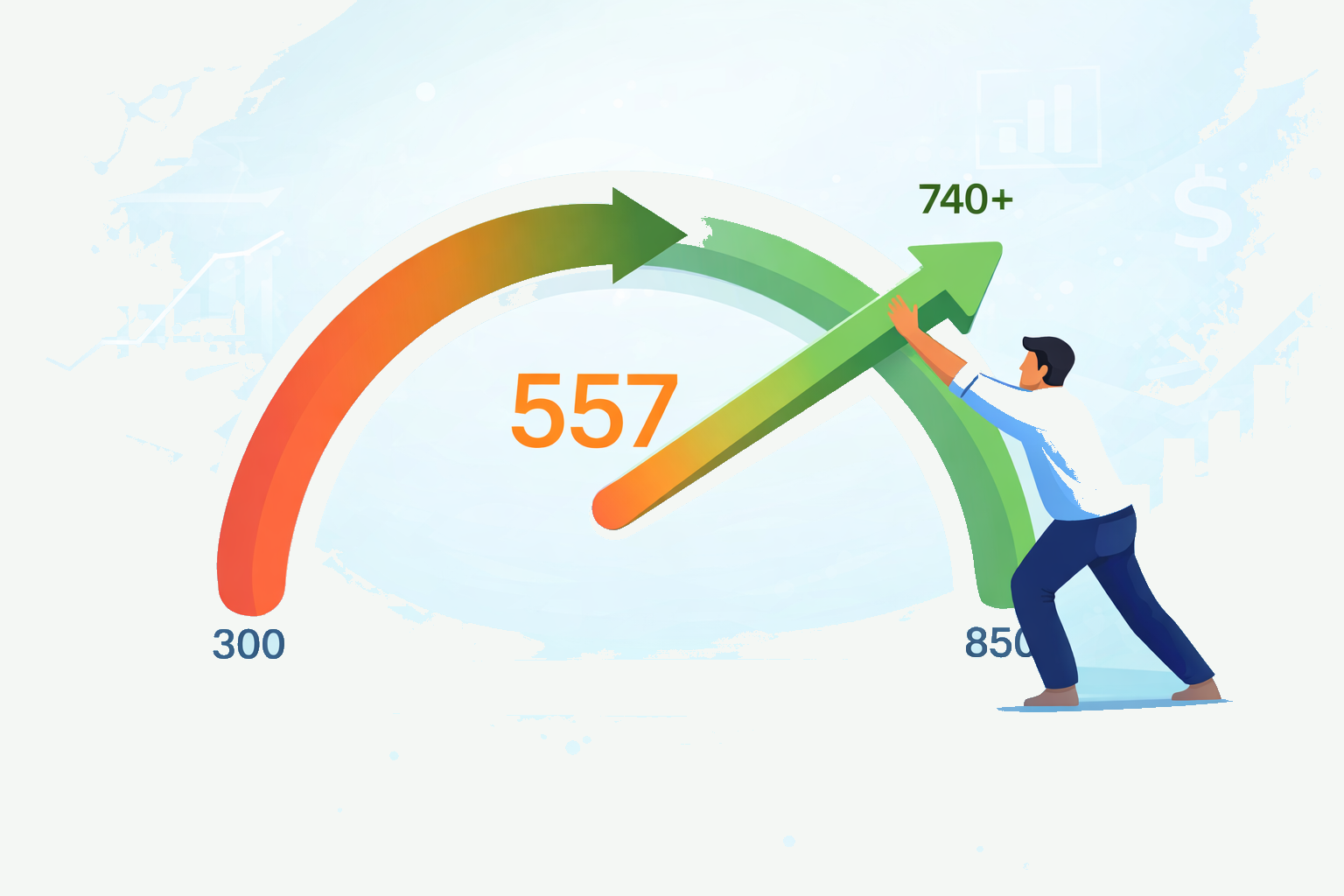
Retirement does not change your credit score. FICO and VantageScore models do not have an “employment status” field, an “age 65” field, or a “fixed income” field. myFICO confirms that salary, occupation, age, and marital status are not used in score calculations. What changes at retirement is the financial structure underneath those factors. Income drops or shifts, expenses get reorganized, the family home goes on the market, long-held credit cards start looking like clutter, and an estate plan starts to matter. Each of those decisions can quietly move the score even though retirement itself is invisible to the model. This guide is the credit-mechanics version of the Master Credit Recovery Roadmap, written for the retirement transition specifically.
Retirement Credit: The TL;DR
- ›Retirement is not a FICO input. Damage comes from closing old cards, limit cuts, and thin-file simplification.
- ›Downsizing on a fixed income works on Social Security, pension, and asset-depletion math; gross-up rules apply.
- ›HECM reverse mortgages do not require a minimum FICO, but HUD requires a financial assessment of credit history.
- ›Get the credit file estate-ready: review beneficiary designations, joint vs. authorized user labels, and report freezes.
The Five Quiet Drag Factors That Hit a Retirement Credit File
The retirement credit file rarely fails for one big reason. It fails for five small ones, often happening in the same eighteen months.
- Closing long-tenured cards. A card that has been open since the early 1990s is the structural floor of your credit age. Closing it does not delete the history immediately, but it stops adding to the average age of accounts and can eventually fall off. It also removes a chunk of available credit, which spikes the utilization percentage on every remaining card.
- Limit reductions on inactive cards. Issuers monitor cards that go unused and can lower the limit or close the account on their own. CFPB guidance on credit card practices confirms that issuers generally have the right to reduce a credit limit on accounts they consider higher risk. Stop using a card for a year and the limit can shrink without warning.
- Oversimplifying the file. “Down to one card” sounds elegant. It is also a thin file. A single revolving account with a small limit can spike utilization on a $500 vacation charge and leaves no room for fraud isolation.
- DTI math against fixed income. When retirees apply for a downsizing mortgage or a HELOC, the lender does not calculate income from old W-2s. It uses Social Security, pension, retirement-account distributions, and rental income. Those numbers usually pencil lower than working-age income, raising the debt-to-income (DTI) ratio. See understanding DTI for the full math.
- Senior-targeted fraud. The FTC’s Consumer Sentinel Network Data Book shows older adults are targeted by specific fraud categories. A new-account fraud event on a retiree file does the same thing it does on a working-age file: drags the score, adds inquiries, and creates dispute work the file owner is least equipped to manage.
Each of these five is a normal credit mechanic. The retirement risk is that they tend to cluster.
Card Simplification Without the Utilization Trap
Many retirees want fewer accounts. Fewer statements, fewer logins, fewer fraud surfaces. The instinct is correct. The execution often hurts the file.
The trap is the same one covered in the utilization trap and the closing-card mechanics in closing credit card effects: when a card closes, its limit comes off the total available credit. The utilization on remaining cards rises overnight even if the dollar balances do not change.
The clean way to simplify:
| Move | What it does to the file | When it makes sense |
|---|---|---|
| Close a newer card; keep the oldest | Preserves credit-age floor; small utilization hit | When the closed card is under five years old |
| Keep the oldest card open with a $5 monthly recurring charge auto-paid | Prevents inactivity closure; preserves limit and age | Almost always, for at least one card |
| Convert a card to a no-fee version (downgrade) | Keeps the line and tradeline age intact | Whenever an issuer offers a downgrade path |
| Ask the issuer to lower the limit on a card you keep | Avoids issuer-driven closure; limited utilization upside | Only if you cannot trust yourself with the limit |
| Close the oldest, highest-limit card | Drops average age, spikes utilization, removes anchor | Almost never |
For the underlying math on how reported balances move the score, see utilization math. The retirement version is the same equation with smaller numbers and tighter limits.
Downsizing the Home: A New Mortgage on a Fixed Income
Downsizing is the single most common retirement-era credit event. The current home is paid off or close to it. The new home is smaller, often in a different state, and the buyer wants to either pay cash or take a small mortgage and keep investments intact.
If you take a mortgage, the lender does not care that you are retired. The lender cares that the income is stable and likely to continue. Fannie Mae Selling Guide B3-3.1-09 treats retirement income, Social Security, and pension income as eligible if properly documented. Three details matter:
- Gross-up. Nontaxable income, including most Social Security retirement benefits, can be grossed up by lenders. Fannie Mae’s general income guidance commonly authorizes a 25 percent gross-up, which can meaningfully improve the DTI calculation.
- Asset depletion. Borrowers with substantial retirement or investment accounts but limited monthly cash flow can use asset-depletion (sometimes called asset-dissipation) income, where the lender treats a portion of qualifying assets as a synthetic monthly income stream after down payment, closing costs, and required reserves are subtracted.
- Three-year continuance. Lenders look for retirement income that will continue at least three years from the application. Traditional employer pensions paid for life generally satisfy this without extra documentation; annuities or temporary distributions with a defined endpoint require evidence of the remaining term.
The five common downsizing-mortgage paths look like this:
| Path | How the lender evaluates it | Credit risks to debug | When it fits |
|---|---|---|---|
| Conventional purchase after retirement | Documented fixed income, assets, DTI, credit, reserves | Thin file, high utilization, limited reserves | Best when retirement income is stable and documented |
| Buy before retirement closes | Current qualifying income if it will continue through closing | Carrying two homes, undisclosed retirement plans, cash drain | Useful only if future cash flow still works |
| Asset-depletion conventional | Eligible assets converted to qualifying income under guide formulas | Large down payment may reduce reserves | Asset-rich borrowers with lower monthly income |
| All-cash purchase | No mortgage underwriting for the purchase itself | Liquidity loss; later HELOC may be harder | Fits when cash remains after the move |
| HECM for Purchase | FHA reverse mortgage path for eligible 62+ borrowers | Financial assessment, property charges, counseling | Large home equity and a low-payment goal |
Borrowers who plan to put 20 percent or more down often assume the loan is automatic. It is not. The credit file still has to clear the same hurdles described in mortgage pre-approval: clean recent payment history, manageable utilization, and a documented income path. The retirement piece is the income paperwork, not a credit shortcut.
Reverse Mortgages and HECM: What Credit Actually Matters
A Home Equity Conversion Mortgage (HECM) is the FHA-insured reverse mortgage product. It is one of the few mortgage products in the United States with no minimum credit-score requirement. That is not the same as “credit does not matter.”
HUD Mortgagee Letter 2014-22 established the HECM financial assessment framework. The lender reviews credit history, property charges (taxes, insurance, HOA), and willingness and capacity to meet ongoing obligations. A pattern of late property-tax payments or recent unpaid collections can lead the lender to require a Life Expectancy Set-Aside, which carves part of the loan proceeds into a reserve account for taxes and insurance. That reduces the cash available to the borrower.
The retirement-credit takeaway: a HECM is more forgiving than a conventional refinance, but the credit file still affects what the borrower walks away with. Cleaning the file before applying still pays off.
ECOA and Age: What Lenders Can and Cannot Hold Against You
The Equal Credit Opportunity Act, implemented through Regulation B section 1002.6, prohibits creditors from discriminating against an applicant on the basis of age, provided the applicant has the legal capacity to contract. A lender cannot deny a sixty-eight-year-old a mortgage because the applicant is sixty-eight.
Two nuances matter for retirement borrowers:
- Regulation B permits a creditor to consider age only in narrow circumstances — primarily as part of an empirically derived credit scoring system or to favor an elderly applicant. A lender cannot shorten a loan term, deny a 30-year mortgage to a qualified 75-year-old, or use life-expectancy estimates as a proxy for repayment capacity.
- A creditor may consider whether the applicant’s income and assets are sufficient to repay the loan. Lower retirement income is a legitimate factor; chronological age is not.
If a retiree feels the conversation with a lender has crossed into age territory, the answer is not to argue with the loan officer. The answer is to keep the application paperwork tight, document the income properly, and if necessary, submit a complaint to the CFPB after the file is in writing.
Senior Fraud Protection Is a Credit Task, Not a Tech Task
A credit-file fraud event hits a retirement borrower the same way it hits anyone else: new inquiries, possibly a new account, possibly a missed payment that lands on the file before the victim notices. The retirement risk is that detection is slower because retirees check credit less often than working-age borrowers.
Three credit-mechanics moves protect the file:
- Freeze all three reports. A free freeze at Equifax, Experian, and TransUnion blocks new accounts unless the file owner thaws first. It does not affect existing accounts and does not lower the score.
- Set issuer alerts on every revolving account. Real-time text alerts on charges over $1 catch most fraud within minutes.
- Pull a free three-bureau report annually. AnnualCreditReport.com is the federally authorized source. Reading the file once a year is the highest-leverage hour of credit work most retirees will do.
For a deeper diagnostic framework, the same logic in credit score debugging applies: identify the suppressor, fix the specific cause, then move on.
Estate Readiness: The Paperwork That Protects the File Later
Credit and estate planning rarely live on the same desk, but they should. A clean credit file at retirement makes the estate side cleaner, and a clean estate plan makes the file easier to administer when something happens.
Three credit-side tasks help:
- Inventory joint accounts vs. authorized user accounts. A joint account creates legal liability for both parties and persists past the death of one signer in different ways than an authorized user link. The post-death mechanics are covered specifically in the companion article: Credit & The Estate: Managing Debt After the Loss of a Spouse.
- Confirm payable-on-death (POD) and transfer-on-death (TOD) designations. Bank and brokerage accounts with POD or TOD designations transfer outside probate. They do not affect credit reports directly, but they reduce the cash-flow pressure on a surviving spouse or executor while credit and tax matters are sorted.
- Document where credit accounts live. A short list of every open card, the issuer, the last four digits, and where statements are sent saves an executor or surviving spouse weeks of guesswork. Store it the same place you store the will.
The intersection with the existing site-wide framework is direct: this is a marriage-and-credit problem in late form. The accounts that were “ours” during the marriage have to become clearly labeled before one signer is gone.
The 5-to-10 Year Retirement Credit Timeline
Retirement credit work is best done before retirement, not during it. The compounding mechanics favor the borrower with a long runway.
| Window | Main credit moves | What you are trying to fix |
|---|---|---|
| 5–10 years before retirement | Build a deep file: keep the oldest cards open and active. Pay down mortgages and HELOCs on schedule. Avoid closing accounts during a high-balance period. | Anchor average account age before income shifts |
| 2–5 years before retirement | Establish two or three primary cards you intend to keep for life. Move recurring charges to those cards. Refinance any high-rate debt while income is still W-2 documented. | Lock in low rates while DTI is favorable |
| 1–2 years before retirement | Open any new cards or lines of credit you expect to want in retirement, while income is still strong. Build a 6–12 month cash reserve. Review beneficiary designations. | Avoid needing new credit on fixed income |
| Year of retirement | Do not close cards in the same quarter income changes. Do not apply for a mortgage in the same quarter pension paperwork changes. Pull all three reports. | Stabilize the file during the noisiest year |
| 1–5 years after retirement | Manage utilization aggressively. Watch for issuer-driven limit reductions. Check reports semi-annually. Update estate documents. | Maintain depth and detect fraud early |
| 5+ years after retirement | Re-evaluate cards with annual fees you no longer use. Consider downgrade paths instead of closures. Coordinate with the executor on file inventory. | Keep the file lean but not thin |
The pattern across the table is the same: every active credit move is best made on the calmer side of an income or estate change, not during it.
How the Credit Optimizer Fits a Retirement File
The Credit Optimizer is the diagnostic tool, not the strategy. For a retirement file, it identifies which suppressor is actually moving the score: utilization on a card whose limit was just cut, a long-tenured account that was closed by the issuer for inactivity, an old collection that should have aged off but is still listed, a thin file after card simplification, or a fraud event that has not been disputed yet.
Order matters. If utilization is the real suppressor, opening a credit-builder loan does not help fast enough. If the file is actually thin, paying down balances another five percent does not move the score much either. The optimizer’s job is to put the levers in the right order so the file owner does not waste a quarter on the wrong move.
For a personalized retirement-file roadmap, upload your three-bureau report to OptimizeCredit.net’s free AI analyzer.
Bottom Line
Retirement does not lower a credit score. The financial choices around it can. Closing the oldest card, accepting a limit cut on an inactive account, oversimplifying the file, or applying for a downsizing mortgage without preparing the income paperwork are the four most common ways the retirement file loses ground. The estate side, fraud risk, and ECOA mechanics add the rest.
The retirement credit roadmap works the same way every other transition roadmap on this site works: build a deep, clean file before the income changes; manage utilization tightly during the change; document the income in the way the underwriter wants to see it; and freeze, monitor, and inventory the file so a surviving spouse or executor can pick it up without surprises. Browse the full Life Transition library for adjacent guides, including the Master Credit Recovery Roadmap and the companion piece on credit after the loss of a spouse.
Related life-transition guides
Get Your Personalized Credit Roadmap
Upload your credit report and our Credit Analyzer identifies what may be holding your score back and provides a step-by-step report-based improvement plan.
Analyze My Credit Free →