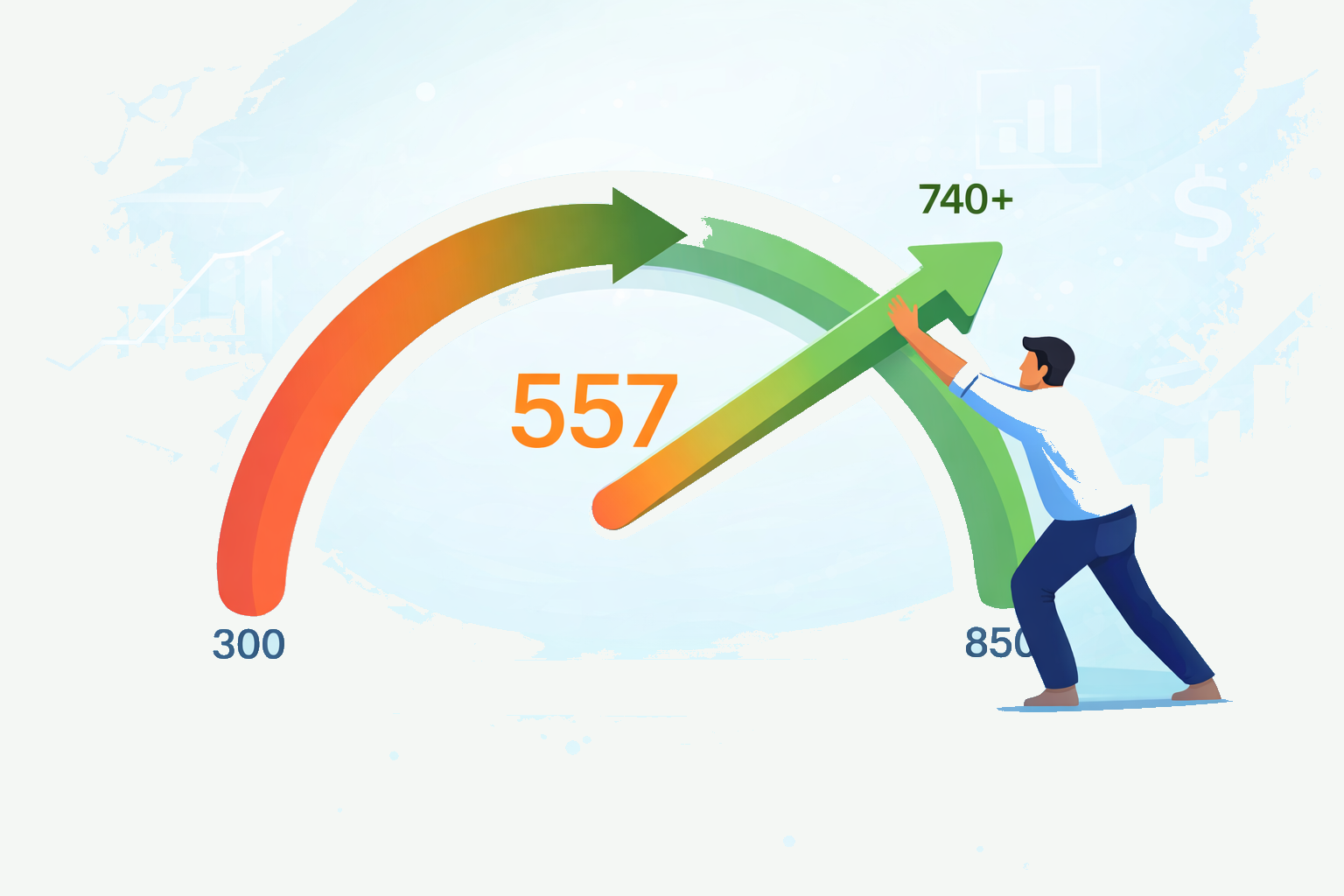
A co-signed auto loan goes 32 days past due because an automatic payment fails when the primary borrower's bank account closes. The cosigner — the borrower's father, who has not seen the loan paperwork in two years — gets an alert from his credit-monitoring app the next morning: his FICO 8 dropped 84 points overnight. He never received a bill, never got a delinquency notice, never knew the autopay failed. That is shared credit debt in one paragraph: how the account was opened — joint account liability, co-signer risk, or authorized user late payment exposure — controls who owes the creditor and whose file takes the hit. Liability and reporting are two different rule sets; most people learn the distinction the hard way.
Shared Credit TL;DR
- ›Joint borrowers and co-signers are usually liable for the full balance; one missed payment hurts both files equally.
- ›An authorized user is generally not contractually liable, but the late account may still report on that person's credit file.
- ›FCRA §623 governs furnisher accuracy duties; FCRA §611 gives you a 30-day (or 45-day) bureau dispute window.
- ›A single 30-day late on a clean high-700s file can drop a score by roughly 60 to 110 points; ranges vary.
- ›A divorce decree does not rewrite the original credit contract; charge-off lands at 180 days for revolving accounts.
How a late payment travels from one shared account to two credit files
Every credit account is reported to the bureaus by a furnisher — usually the bank or lender that owns the contract. Furnisher conduct is governed by FCRA §623 (15 U.S.C. §1681s-2). The furnisher has a legal duty to report accurately and to investigate disputes once a bureau forwards them.
When a shared account goes 30 days past due, the furnisher writes a single delinquency record into its monthly reporting file and tags every consumer attached to that tradeline. Equifax, Experian, and TransUnion ingest the file and apply the late mark to each tagged consumer's credit report. The score impact is identical for each obligor because each one's file now carries the same 30-day late on the same account. There is no proportional split. There is no “primary” and “secondary” weighting in the score. One late, two or three identical hits.
Score impact varies by FICO 8, FICO 9, and VantageScore 4.0 model, but a single 30-day late on a clean high-700s file can drop a score by roughly 60 to 110 points. The bureau does not know who used the card — only what the furnisher reported. (See how credit cards report for cycle-to-bureau mechanics.)
Joint accounts — both names, both files, full liability
A joint account is one credit contract with two or more obligors who are jointly and severally liable — both names on the application, both signatures on the agreement. The lender can collect the full balance from either party. Joint account liability does not split the debt in half; each borrower is on the hook for 100% of the balance.
Joint accounts report to every obligor's file under FCRA §623. The Date of First Delinquency (DOFD) is set when the account first goes 30 days past due, and that DOFD propagates to each obligor's record. The 7-year credit-reporting clock under FCRA §605 starts running on the DOFD, not on later activity. Even if a joint account is brought current after a 60-day late, the late marks at 30 and 60 days remain on both files for seven years from the original DOFD.
The most common joint structure is a credit card opened during marriage. The second-most common is a HELOC or mortgage. In both, late-payment reporting is non-negotiable: you cannot remove your name from a joint account without paying it off, refinancing, or persuading the creditor to release one obligor (rare, except on mortgages with formal assumption procedures). For the broader framework on how joint, co-signed, and AU structures work in steady state, see the parent guide on shared credit structures.
Co-signed loans — the cosigner is liable but often has zero visibility
A co-signed loan is structurally similar to a joint account: both names sit on the contract, both are liable. The practical difference is that the cosigner usually does not receive statements, autopay control, or delinquency notices unless the lender chooses to send them. The cosigner's first signal that something has gone wrong is often a credit-score alert. That is the core co-signer risk: full liability with less practical control.
Federal trade rules require a written notice of liability before signing (the FTC Cosigner Notice, 16 CFR §444), but lenders typically default to billing only the primary borrower — which is exactly how a 32-day late can ambush a cosigner who has not heard about the loan in two years.
Co-signed loans show up on the cosigner's credit report as an installment tradeline counted in DTI, utilization (for credit cards), and payment history. The cosigner's credit profile carries the same exposure as the primary borrower's profile, with none of the day-to-day visibility.
Authorized users — usually no liability, but the late mark can still land
The authorized-user (AU) case is the one most people get wrong. The AU is generally not contractually liable to the issuer for charges on the card. The cardholder is the only person the issuer can sue. But the issuer typically reports the tradeline to the bureaus, and the bureaus typically copy it onto the AU's file. (This is the same mechanic that makes authorized user tradelines a credit-building tool when the account is in good standing.)
When a card with AUs goes late, the issuer's reporting file marks the tradeline as 30 days delinquent. Whether that authorized user late payment lands on the AU's file depends on the issuer's policy. Some major issuers strip negative AU records before transmission to the bureaus; others do not. Once the late shows up on the AU's file, FCRA §611 disputes are the standard path to remove it, often successful because the AU has no contractual liability.
The AU should also ask the issuer to remove their authorization on the account. Once removed, future furnisher reports usually stop placing the tradeline (positive or negative) on the AU's file. Past entries may persist until the issuer corrects them or until the 7-year reporting clock under FCRA §605 runs out.
Comparison: liability vs. reporting vs. removal path
| Structure | Liable to creditor? | Late reports to file? | Easiest removal path |
|---|---|---|---|
| Joint account | Yes — joint and several | Yes, on every obligor | FCRA §611 dispute or goodwill letter to issuer |
| Co-signed loan | Yes — cosigner fully liable | Yes, on cosigner's file | Co-signer release, refinance, or pay-to-delete |
| Authorized user | No (in most cases) | Often yes | AU removal + FCRA §611 dispute |
The 30/60/90/120/150-day timeline and what happens at charge-off
Late payments are bucketed by furnisher convention into 30-day increments. Each bucket carries a different score and credit-policy consequence:
- 30 days late — first time the bureau sees the delinquency. DOFD is set here. Score drop on a clean high-700s file is roughly 60 to 110 points; ranges vary.
- 60 days late — second reporting cycle still delinquent. Adds another negative entry. The lender may begin formal collection calls.
- 90 days late — three months past due. Many issuers begin acceleration of the balance and may report the account as “seriously delinquent.”
- 120 days late — four months past due. Charge-off processing begins for many revolving products.
- 150 days late — penultimate reporting cycle before charge-off. The account is on the regulatory clock.
- 180 days late (charge-off) — under Federal Financial Institutions Examination Council policy on revolving accounts, the issuer typically classifies the balance as a loss. Both joint obligors take the charge-off mark. The balance often transfers to a collection agency or in-house recovery group. Joint-and-several liability allows the issuer to sue either party for the full balance.
(For deeper mechanics on what each of these buckets does to the score itself, see late payment impact on credit.)
The 7-year reporting window under FCRA §605 runs from the original DOFD, not from charge-off. A late that went into charge-off in month 7 is reportable for seven years from the month-1 DOFD, not from the charge-off date. The statute of limitations for actually suing on the debt is separate — varies by state, typically 3 to 6 years, and usually runs from the date of last payment.
How to remove a late mark from a shared account (FCRA §611 procedure)
FCRA §611 (15 U.S.C. §1681i) gives the consumer the right to dispute any item on a credit report. The bureau has 30 days to investigate and respond. If the consumer supplies additional documentation during the investigation window, the deadline extends to 45 days.
The dispute procedure for a shared account:
- Pull all three reports from AnnualCreditReport.com (free, statutory entitlement). Check the account type, responsibility field, balance, payment history, status, and dates. On shared accounts, look for mismatches: one bureau showing joint, another showing authorized user, or one file showing 60 days late when the account was only 30 days past due.
- Identify the disputed late mark by account number, furnisher, and DOFD.
- File the dispute with the bureau showing the mark — by mail, online, or through the CFPB Consumer Complaint portal for a furnisher that is dragging its feet.
- Supply documentation: payment records, the original credit agreement (helpful for AU removal arguments), divorce decree (note: not binding on the creditor but useful for context), or evidence of identity theft.
- Receive the bureau's response within 30 (or 45) days. If the late is verified as accurate, escalate to a goodwill letter directly to the furnisher.
Effective dispute angles include miscoded responsibility (joint when you were only AU), wrong delinquency bucket, misapplied payments, deferment or forbearance not honored, identity theft, or wrong DOFD after charge-off. “My ex was supposed to pay,” “I never used the card,” and “I never received the statement” are usually not sufficient.
A goodwill letter is not a legal procedure — it is a relationship request. Many issuers will agree to a one-time courtesy removal of a single 30-day late on an otherwise clean account, especially if the underlying cause was an autopay failure or a documented hardship. They do not have to. They sometimes do. The full step-by-step is in our credit dispute guide.
Exit ramps once the late mark has hit
Once a late payment is on the file, four realistic moves remain:
- Refinance. Move the debt to a new, single-borrower loan. The original tradeline closes. The new tradeline reports clean from day one. The closed account still shows the historical late marks, but future liability is severed.
- Co-signer release. Some auto loans, mortgages, and private student loans have a contractual cosigner-release clause after a defined number of on-time payments. The cosigner exits the contract and stops being liable. Recent late marks often disqualify a release request until a new clean payment streak is established.
- Pay-to-delete. A negotiated settlement where the creditor agrees in writing to remove the negative tradeline in exchange for full or partial payment. Less common with original creditors, more common with collection agencies after charge-off. Get the deletion promise in writing before paying.
- Wait it out. Late marks fall off seven years from the DOFD under FCRA §605. The score impact diminishes well before that — most of the damage is in the first two years.
For families coming out of a divorce-driven credit reset or working a longer-arc recovery timeline, refinance and co-signer release are the cleanest exits.
Special cases: divorce, death, identity theft, SCRA
Divorce. A divorce decree assigns marital debt between spouses but does not unwind the original credit contract. The Equal Credit Opportunity Act and Regulation B treat the creditor as a non-party to the family-court order. If your decree gives a joint card to your ex and the ex pays late, the late mark lands on your file too. The fix is to refinance, pay off, or get the ex's name removed by the issuer — not to wave the decree at the bureau.
Death of a co-obligor. A surviving joint obligor is generally still liable for the full balance. The deceased's estate may also be liable, depending on state law. Notify the issuer in writing and request the account be closed to new charges; ongoing reporting is then keyed to the survivor only.
Identity theft on a joint account. If someone forged your signature or opened a joint account without authorization, file a police report and use the FCRA §605B identity-theft block procedure to remove the fraudulent late mark — this is faster than a §611 dispute when fraud is documented. Identity theft is different from regret: if you knowingly signed and the other person later broke a promise, that is a contract problem, not identity theft.
SCRA protection. The Servicemembers Civil Relief Act provides procedural protections for active-duty servicemembers, including a 6% interest cap on certain pre-service debts and pause on default judgments. SCRA does not erase a late mark already reported, but it can stop aggressive collection activity during deployment.
When to escalate to the CFPB or a consumer attorney
Most shared-account late-payment situations resolve through the bureau dispute process or a direct goodwill request to the issuer. Escalate when:
- The furnisher fails to respond to a §611 dispute within 30 (or 45) days.
- The bureau verifies a late as accurate when you have documentation showing it is not.
- The issuer continues reporting an AU tradeline after written removal request.
- You suspect the issuer is violating the Fair Debt Collection Practices Act on a charged-off shared account.
The first escalation is the CFPB Consumer Complaint portal — submission triggers a regulator-tracked response window. If the issuer does not resolve, a consumer-rights attorney can file under FCRA §616 (willful) or §617 (negligent) for actual damages, statutory damages, and fees. Talk to an attorney quickly if you are sued or facing mixed-file or identity-theft reporting that blocks housing, employment, or lending.
Bottom line — the one question to ask before you sign anything shared
Before you co-sign, joint-open, or accept an AU invitation, ask one blunt question: if this account goes late, whose credit file takes the hit, and what does it take to get me out? Shared credit debt only works when the exit plan is as clear as the approval.
If a Shared Late Mark Is Already on Your File
- Pull all three reports from AnnualCreditReport.com and confirm exactly how the account is reported on each bureau.
- Check the responsibility field (joint, co-maker, authorized user) for accuracy — mis-coding is a common dispute lever.
- File an FCRA §611 dispute with documentation if the reporting is wrong; send a goodwill letter to the issuer if it is right.
- If you are an AU, request issuer removal in writing and follow up with a bureau dispute if the tradeline persists.
- Identify your exit ramp from the shared credit debt: refinance, co-signer release, AU removal, payoff, or pay-to-delete settlement.
- Baseline your full file with the Credit Optimizer before you decide which lever to pull.
Related life-transition guides
- How to rebuild credit after divorce and untangle joint liability.
- How joint accounts, co-signers, and authorized users actually work.
For related pillar content, see rebuilding credit after divorce or browse the full Life Transition library.
Get Your Personalized Credit Roadmap
Upload your credit report and our Credit Analyzer identifies what may be holding your score back and provides a step-by-step report-based improvement plan.
Analyze My Credit Free →